Why Your RV Fits on Paper but Fails in Storage
A 40-foot coach owner once reserved what looked like the perfect RV storage space online the night before a holiday weekend. The listing matched the RV’s length. The monthly rate looked fair. The photos suggested easy access. On paper, it checked every box.
By Friday afternoon, that “fit” had turned into a four-figure mistake.
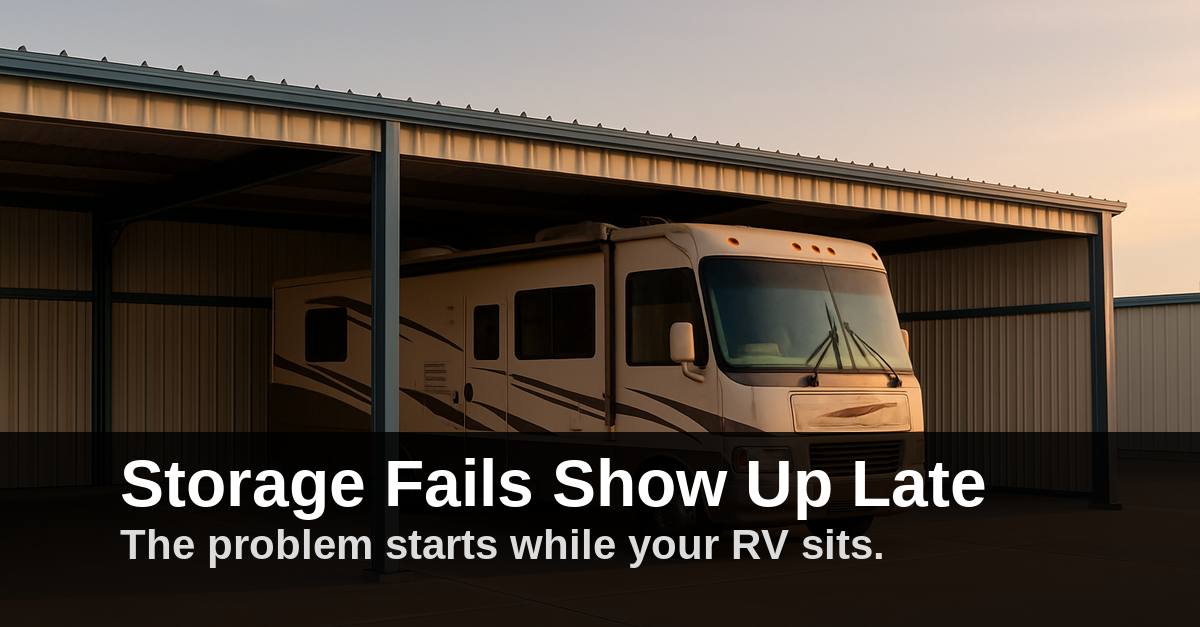
The coach made it through the front gate, but only barely. The covered roofline dipped lower at the edge than the listing implied. A drain curb narrowed the aisle near the assigned row. The backing angle into the stall was tighter than expected, and after two corrections the driver clipped a mirror housing on a steel post. The repair bill hurt, but the larger cost was operational: delayed departure, missed campsite check-in, a shortened first night, extra stress, and one more reminder that an RV can fit on paper and still fail in storage.
That is how most storage mistakes happen. The listed dimensions are not always wrong. They are incomplete.
Many owners shop for indoor RV storage, covered RV storage, or outdoor RV storage the way they shop for a parking space: compare the listed stall length to the rig length, scan the price, look at a photo or two, and move on. That shortcut is understandable because length is the easiest metric to advertise and compare. But length only describes the parked condition. It says very little about whether your RV can reach the space, turn into it, back into it, clear the roofline, or sit there in a way that still lets you use it.
A better framing is operational, not just spatial. This is not merely a parking decision. It is a risk-management, workflow, and decision-quality decision. A workable RV storage unit size has to function from entrance to final parked position, repeatedly, under normal conditions. If the gate is too narrow, the aisle is too tight, the turning geometry is unrealistic, or the clearance is so close that you must inch in perfectly every time, then the space does not fit in any practical sense.
The cost of getting RV storage dimensions wrong stacks up fast:
- Minor mirror, trim, or corner-panel damage can run from a few hundred dollars to several thousand.
- Emergency upgrades to a larger space can mean a higher monthly rate, transfer hassle, and move-in fees.
- Difficult storage setups can add 20 to 40 minutes to every departure and return.
- Friction-heavy storage increases the odds that owners skip pre-trip checks, rush unloading, postpone maintenance, or simply use the RV less often.
Take a simple comparison. Owner A pays $110 per month for a tight outdoor space and spends 25 extra minutes on each pickup and return, 18 trips a year. That is 900 extra minutes, or 15 hours of friction, before counting stress or damage. Owner B pays $150 for a more forgiving stall with wider aisles and cleaner access. The extra $40 per month costs $480 a year. For many professionals, 15 hours of regained time plus lower damage risk is easily worth more than that. In business terms, the cheaper option can carry the higher operating cost.
The core lesson is simple: storage is not just about whether the RV fits. It is about whether the space works.
Why length-only sizing fails
The easiest number to compare is length, so it becomes the number people trust most. Reservation pages sort by it. Facility managers quote it first. Renters remember it. Unfortunately, it is often the least useful number on its own.
A 35-foot space can still fail a 35-foot rig. The reason is simple: parked size and operating size are not the same thing.
Parked size is the rectangle your RV occupies when the maneuver is complete.
Operating size includes everything required to get there safely and use the space normally:
- gate approach
- mirror-to-mirror width
- tow vehicle setup room
- turning radius
- rear swing
- backing angle
- room for corrections
- ability to open the doors and bays you actually use
This distinction becomes obvious when you think about what happens in the real decision moment.
On a listing page, you may see “40 x 12 covered RV storage.” That sounds precise. But what does it leave out? Whether the 12-foot figure refers to the interior height at the center or the lower edge at the side. Whether support posts reduce the practical entry line. Whether the aisle is wide enough for a long-wheelbase coach to set up for the turn. Whether neighboring rigs are usually parked close enough to remove your correction room. The listing answers the easy question and hides the hard one.
A few rig-type examples make this clearer.
Class A motorhome
A 38-foot diesel pusher may physically sit inside a 40-foot covered stall. But if the row entrance is square and the post line sits near the turn, the driver may need a wider setup than the aisle allows. Add rear overhang and the real risk becomes the back corner, not the front bumper.
Class C motorhome
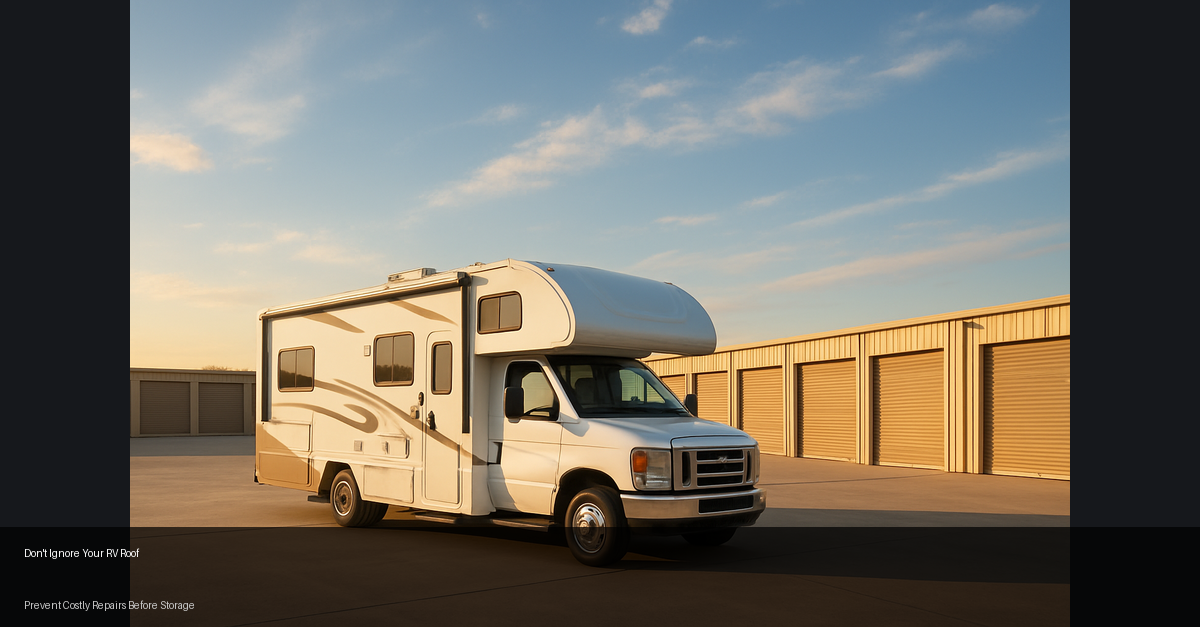
A 31-foot Class C may seem easier because it is shorter. But cab-over shape, mirror width, and a keypad island near the gate can create an awkward approach that pushes the driver close to a wall or bollard before the storage process even begins.
Travel trailer
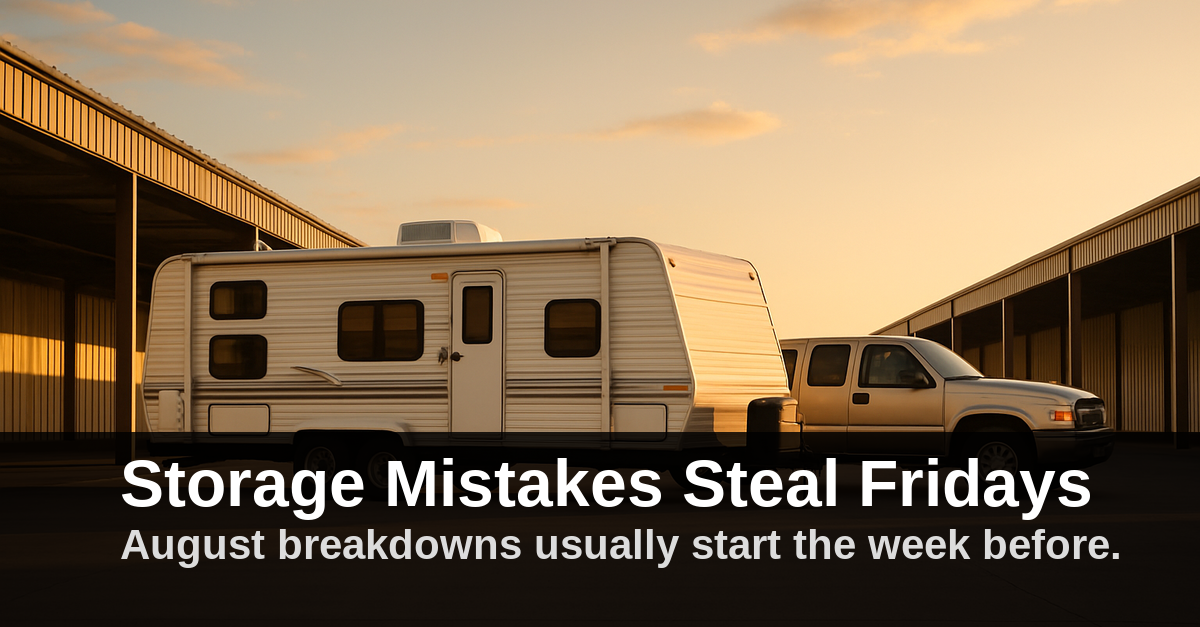
A 32-foot travel trailer stored with a pickup often needs more maneuvering space than first-time renters expect. The trailer may fit on the pad, but the truck needs lane width to pull wide, set the angle, and back without jackknifing into a fence or neighboring unit.
Fifth wheel
A fifth wheel often backs more predictably than a bumper-pull trailer for experienced drivers, but it still needs substantial setup room. A front-corner post in covered storage can destroy what looked like a clean line into the stall.
Class B van
A Class B usually has fewer length problems, but indoor storage can still fail on door width, interior columns, or rear-door access. A van that fits easily can still become operationally annoying if mirrors must be folded every time or the rear cargo doors cannot fully open.
A useful rule for how to choose RV storage is this: the listed stall size tells you where the RV ends up. It does not tell you whether the layout supports the maneuver required to get there.
Reader exercise: parked size vs. operating size
Open your phone notes and make two columns.
Column 1: Parked size
- overall length
- widest body dimension
- overall height
Column 2: Operating size
- mirror width
- turning needs of the rig or truck-and-trailer combo
- space needed for backing corrections
- lowest clearance point required on the route
- doors or compartments that must open after parking
If Column 2 contains more uncertainty than Column 1, you do not know enough to reserve confidently.
The dimensions owners forget
Most storage failures are caused not by one dramatic measurement error, but by several smaller overlooked dimensions. This is why any useful RV storage size guide has to go beyond length.
1) Height: measure the real highest point
Height is the first trap, especially in indoor RV storage and covered RV storage. Many owners remember the brochure height from purchase day. Fewer know the true current height after adding:
- roof air conditioners
- vent covers
- solar panels
- satellite domes
- antennas
- ladder accessories
- cargo pods
A facility may advertise 12-foot clearance, but if your actual highest point is 12 feet 2 inches, that listing is not close enough to matter.
Quick measuring process
- Park on level pavement.
- Identify the highest rooftop item, not just the roofline.
- Lay a straight board or long level across that point.
- Measure from ground to top of the board.
- Repeat if possible on a slight incline, because approach slope can reduce effective clearance.
- Record the larger number.
- Add a comfort margin of at least 3 to 6 inches.
Example: a motorhome measured 11 feet 11 inches at purchase. After a vent cover and low-profile solar were added, real height became 12 feet 2 inches. The owner still thought of it as “basically 12 feet” and nearly booked a covered bay listed at 12 feet.
2) Width: measure the widest operating point
Width is often underestimated because manufacturers emphasize body width, not usable width in motion.
For storage decisions, measure:
- mirror-to-mirror width for motorhomes
- widest trailer fender or awning-arm point for towables
- any accessory that protrudes in storage mode
If access requires folding mirrors every time, treat that as a warning sign rather than a clever solution. Repeated tight-clearance routines are exactly how mirrors get damaged.
3) Length: include the real total
Length still matters. It just cannot do the whole job alone. Measure the full bumper-to-bumper or hitch-to-rear dimension as the RV is actually stored. Spare tire mounts, bike racks, cargo trays, and ladder accessories can all change the working number.
This matters on listing pages where a facility offers 25-foot, 30-foot, 35-foot, and 40-foot spaces. If your trailer is “about 30 feet” in sales language but 33 feet 8 inches in real storage length, the 30-foot option is not a discount. It is a mistake waiting to happen.
4) Slide, door, and bay access
Many owners say they do not need slides open in storage. Often true. But they still need selective access.
Ask:
- Can I open the main entry door comfortably?
- Can I reach the battery disconnect?
- Can I access the pass-through or utility bay?
- Can I retrieve hoses, tools, or leveling blocks?
- Can I load groceries or trip gear without moving the RV again?
A trailer can fit perfectly by length and width and still fail if you cannot open the one compartment you use every weekend.
5) Mirror and awning-arm clearance
Mirrors and awning arms are common low-speed damage points because they sit at the margins where posts, walls, and neighboring rigs become problems. Ask not just “Will it fit?” but “Which vulnerable part of my rig reaches the narrowest point first?”
Reader exercise: build a one-minute measurement card
Save this in your phone:
- true height
- body width
- widest operating width
- total stored length
- must-open doors or bays
- minimum clearance margin you want
That note turns vague phone calls into useful ones.
Indoor vs. covered vs. outdoor storage: where sizing traps differ
Price and weather protection matter, but each storage type creates a different pattern of risk. So if you are asking how much space an RV needs, the answer depends partly on storage type.
| Storage type | Main advantage | Common failure points | Best fit for |
|---|---|---|---|
| Indoor RV storage | Maximum weather and security protection | Door height, door width, columns, interior turns, offset approaches | Owners with exact measurements who want premium protection |
| Covered RV storage | Good protection at moderate cost | Canopy edge height, support posts, angled backing under roof | Rigs that clear easily and line up cleanly |
| Outdoor RV storage | Usually lowest cost and best vertical freedom | Narrow spacing, slope, curb edges, congestion | Owners who need simpler height clearance and easier overhead margin |
Indoor RV storage
Indoor sounds premium, and often is. But it is also the least forgiving. The door opening may be the real constraint, not the bay behind it. Interior columns can tighten turning lines. A building approach that is slightly offset from the drive lane can force a sharper entry angle than expected.
What owners often see online: a clean building photo and a note that says “12’ x 40’ indoor.” What they do not see: the 11-foot-10-inch side edge under the roll-up track, the narrow entry apron, or the support column three feet inside.
Best use case: owners who want maximum protection and have comfortable measurement margin, not exact-match numbers.
Covered RV storage
Covered storage looks easier because the sides are open, but open sides do not remove the posts. In many layouts, post placement is the deciding factor.
What goes wrong during arrival: the driver clears the canopy height, but the setup angle into the stall puts a mirror or trailer corner too close to the first post. The space works only after multiple corrections or only when the opposite lane is unusually empty.
Best use case: rigs that have enough height margin and enough aisle width to back in without threading a needle.
Outdoor RV storage
Outdoor storage is often the most forgiving vertically and sometimes the easiest option for larger rigs. But it has its own traps: drainage swales, uneven gravel, soft shoulders, narrow pad spacing, and seasonal congestion.
What owners often miss on tours: they visit at 10 a.m. on a quiet Tuesday. The lot feels open. Their actual return pattern is Sunday evening or Friday before a holiday, when nearby rigs, tow vehicles, and people loading gear change the geometry.
Best use case: owners who prioritize straightforward access and can tolerate less weather protection.
A total-cost lens
If you use your RV often, storage type affects more than weather exposure. It affects loading time, departure speed, error rate, and even how willing you are to use the unit spontaneously. That makes this a total-cost decision, not just a monthly rent decision.
The access path matters as much as the space
A storage space is only as good as the route that leads to it. This is where RV storage clearance, aisle width, turning radius, and backing angle become practical, not theoretical.
What to inspect on the listing page
When you first evaluate a facility online, look past the marketing photos. Check for:
- gate photos taken straight-on rather than at an angle
- row images that hide aisle width
- absence of overhead photos or site maps
- listings that give stall size but no clearance data
- language like “various sizes available” without exact dimensions
Those omissions are not proof of a bad facility. But they are signs that you need more detail before reserving.
What to confirm during the phone call
Ask for:
- exact gate opening width
- lowest overhead clearance on the route
- aisle width between occupied rows
- whether the route includes tight turns, curbs, or posts
- whether your assigned row is easier or harder for large rigs
- whether return traffic tends to create congestion
If the employee can answer clearly, good. If the answer is “You should be fine,” you still do not know enough.
What commonly goes wrong during arrival
This is the moment many owners fail to picture in advance.
You arrive after work. The sun is low. Another customer is stopped near the gate. You punch in the code while hugging the curb to clear a keypad island. You turn into the main aisle and realize the row is tighter than the photos suggested. A neighbor’s trailer sits a little crooked. The row you expected to back into straight now requires a sharper setup. You pull forward for a correction, but a drain edge or fence line cuts off the angle. Now the maneuver is possible, but not repeatable without stress.
That is a failed fit, even if the RV technically ends up in the stall.
Practical route factors
Gate width: A 12-foot gate can behave like an 11-foot gate if bollards, curbs, or one-way entry geometry reduce usable width.
Aisle width: One of the most important RV storage dimensions, especially for towables. Aisle width determines whether the truck has room to create the angle the trailer needs.
Turning radius: Most facilities do not advertise this. You infer it from corners, islands, fence returns, and how tightly rows are arranged.
Backing angle: The final 20 feet often matter more than the first 200. A stall can fail because the last move is too sharp.
Slope and drainage: Even a modest slope changes effective clearance and wheel path. Curbs and swales remove setup room.
Congestion: The same space behaves differently when nearby rows are full.
Reader exercise: route audit scorecard
Score each category from 1 to 5:
- gate access
- aisle width
- corner openness
- backing angle
- slope and drainage
- congestion risk
Any 1 or 2 deserves follow-up before you sign.
Questions to ask before signing: a practical call script
General questions like “Will my RV fit?” usually produce general answers like “You should be fine.” That is not decision support. It is risk transfer.
Use exact numbers and ask exact questions.
Call script
“Hi, I’m checking whether a space will work for my RV. My measurements are:
- length: ___
- true height: ___
- body width: ___
- mirror width or widest operating width: ___
- rig type: ___
- must-access compartments: ___
Can you help me confirm:
- the exact gate width
- the lowest clearance point on the route
- aisle width between occupied rows
- whether there are sharp turns, posts, or curbs near my row
- the backing angle into the assigned space
- whether I can open my entry door and key compartments once parked?”
Then stop talking and listen for whether the answer comes from knowledge or assumption.
Strong follow-up requests
- “Could you send a photo with the opening measured?”
- “Do you have a site map showing my row?”
- “Can you send a short drive-through video from gate to unit?”
- “Do larger rigs use that section regularly?”
- “Does it get tighter on weekends when more spaces are occupied?”
- “Can I switch rows if the fit is borderline?”
Red-flag answers
Be cautious if you hear:
- “It should be fine.”
- “People get big rigs in here all the time.”
- “I’m not sure of the exact clearance.”
- “You can always fold the mirrors.”
- “It works if the other spots are empty.”
Those are not confirmations. They are warnings in disguise.
A simple decision table: cheap space vs. workable space
To make the tradeoff concrete, compare options across more than monthly price.
| Factor | Space A | Space B |
|---|---|---|
| Listed Size | 35' outdoor | 40' covered |
| Gate and aisle margin | Tight | Comfortable |
| Average extra maneuver time per tip | 20 min | 5 min |
| 8 annual trips total friction | 12 hours | 3 hours |
| Door/bay access after parking | Partial | Full |
| Damage risk | Elevated | Lower |
| Decision quality under stress | Poorer | Better |
If Space B costs $40 more per month, that is $480 more per year. But if it saves 9 hours annually and materially lowers the odds of one $800 mirror repair, the economics may strongly favor the more expensive option.
For professionals, this is the right lens: cost of friction, cost of error, and reliability of process.
The final decision test: a concrete yes/no framework
Most bad-fit spaces reveal themselves before the contract is signed. The key is to judge them by repeatability, not possibility.
A space does not pass because you can force the RV into it once. It passes only if you can use it routinely, calmly, and safely.
Clearance test
- Do you have reliable height margin at the lowest point?
- Do you have width margin without relying on folded mirrors?
- Can you avoid posts, curbs, and pinch points without precision-level stress?
Route test
- Can you clear the gate comfortably?
- Can you make major turns without excessive correction?
- Is the turning geometry realistic for your rig type?
Parking test
- Can you back into or pull into the space under normal occupancy?
- Does the angle allow at least modest correction room?
- Can you leave again without depending on neighbors being absent?
Usability test
- Can you open the entry door you need?
- Can you reach key bays or compartments?
- Can you load, unload, and prep without recurring frustration?
Stress test
Now imagine a realistic bad day:
- after dark
- light rain
- holiday traffic behind you
- a neighbor parked crooked
- you are tired and trying to get home
Would the setup still work without luck?
If the honest answer is no, keep looking.
Pass/fail rule
A space is a yes only if:
- the dimensions work with margin
- the route works under normal occupancy
- the maneuver is repeatable
- the space supports the access you actually need
A space is a no if:
- it depends on inches you cannot confidently control
- it requires perfection
- it works only when the lot is half empty
- it forces recurring workarounds
Final thought
The reason an RV fits on paper but fails in storage is that paper measures the final rectangle while real life tests the full operating process. Owners who use an actual RV storage size guide, measure real RV storage clearance, and think through how much space an RV needs from gate to final position make better decisions. They lower operational risk, protect time, reduce damage costs, and improve the total economics of ownership.
Before you reserve or renew, do one thing differently: measure the route, not just the spot.
About the author
Jamie Marshall is a consultant and SE who builds companies with media and technology. Check out JMus.